





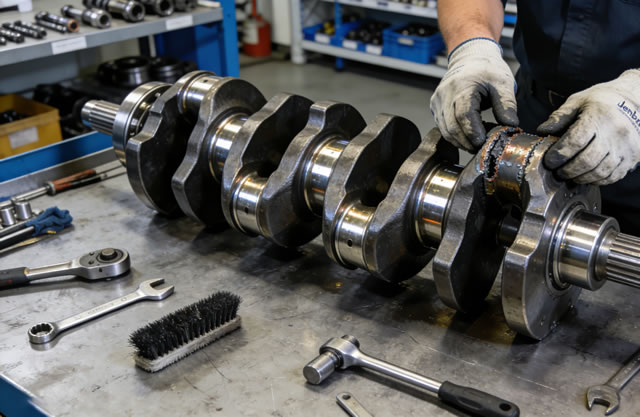
The Jenbacher crankshaft is the core rotating component of Jenbacher gas engines, converting the linear motion of pistons into rotational mechanical energy to drive industrial equipment, power generators, and other heavy-duty systems. As one of the most heavily loaded engine parts, Jenbacher crankshafts (typically forged from high-strength alloy steel or nodular cast iron) operate under extreme conditions: continuous cyclic loading, high rotational speeds (up to 1800 RPM for Jenbacher J-series engines), thermal expansion, and friction between crankpins and connecting rod bearings. Improper maintenance of crankshafts can lead to journal wear, fatigue cracks, bending, or even complete fracture—resulting in catastrophic engine failure, prolonged downtime, and exorbitant repair costs. This comprehensive guide outlines all critical aspects of Jenbacher crankshaft maintenance, from pre-inspection preparation to long-term storage, to ensure maximum service life and operational reliability.
1. Fundamental Understanding of Jenbacher Crankshaft Design
Jenbacher crankshafts are engineered to meet the unique demands of gas-fueled engines, with design features tailored to different models (J200, J400, J600, J920 FleXtra):
- Precision-machined journals: Main journals (supporting the crankshaft in the engine block) and connecting rod journals (crankpins) are finished to micron-level tolerances (typically 0.001–0.003 mm) to ensure proper bearing fit and oil film formation.
- Counterweights: Strategically placed counterweights balance the rotational mass of pistons and connecting rods, reducing vibration and stress on the crankshaft and engine block.
- Oil passages: Internal drilled oil passages deliver pressurized lubrication to journals and bearings, preventing metal-to-metal contact and dissipating heat.
- Surface treatments: Most Jenbacher crankshafts feature induction-hardened or nitrided journal surfaces (hardness up to 60 HRC) to resist wear and fatigue.
- Flange and keyway design: The rear flange connects to the flywheel/driveline, while keyways secure timing gears—both require strict alignment to avoid torsional stress.
These design characteristics demand maintenance practices that prioritize precision, cleanliness, and adherence to Jenbacher OEM specifications—deviations (e.g., incorrect bearing clearance, over-torquing fasteners) will accelerate wear and compromise structural integrity.
2. Pre-Maintenance Preparation: Safety & Tooling
Crankshaft maintenance involves disassembling major engine components and handling heavy, precision parts (a Jenbacher J600 crankshaft weighs over 500 kg). Proper preparation is critical to avoid accidents, component damage, or inaccurate inspections.
2.1 Non-Negotiable Safety Protocols
- Complete engine shutdown & isolation: Shut down the engine, disconnect all power sources (electrical, fuel, gas), and lock out/tag out (LOTO) all systems to prevent accidental startup. Allow the engine to cool fully (4–6 hours) to avoid thermal expansion-related measurement errors and burn risks.
- Secure lifting equipment: Use certified lifting slings (nylon or synthetic—avoid steel slings that scratch crankshaft surfaces) and a calibrated hoist with a weight capacity of at least 1.5x the crankshaft weight. Always use spreader bars to distribute load evenly and prevent bending during lifting.
- Controlled workspace: Clear the area of debris, flammable materials, and loose tools. Use anti-slip mats for footing, and ensure adequate ventilation (especially when using solvent-based cleaners). Wear PPE: nitrile gloves (prevent oil contamination/skin irritation), safety glasses (protect from debris), and steel-toe boots (for heavy component handling).
- Team coordination: Never handle the crankshaft alone—at least two trained technicians are required for lifting/moving to avoid sudden shifts or drops.
2.2 Essential Tools for Crankshaft Maintenance
- Precision measuring tools: Dial bore gauge (0.001 mm resolution), micrometer set (for journal diameter measurement), dial indicator (for runout/bending checks), and surface roughness tester (Ra/Rz scale).
- Cleaning supplies: Low-residue solvent (Jenbacher-approved degreaser), ultrasonic cleaner (for oil passage cleaning), soft-bristle nylon brushes (non-abrasive), lint-free microfiber cloths, and compressed air (oil-free, 70–90 PSI).
- Inspection equipment: Magnetic Particle Inspection (MPI) kit (detect surface cracks), dye penetrant test (DPT) kit (for non-magnetic materials), and magnifying lamp (10–20x magnification).
- Assembly tools: Torque wrench (calibrated to Jenbacher specs, 1/2” or 3/4” drive), torque angle gauge, bearing scraper (plastic/wood—avoid metal), and anti-seize lubricant (Jenbacher PN: 000123456).
- Support equipment: Crankshaft stand (soft-jawed to prevent journal damage), V-blocks (precision-ground), and alignment pins (OEM-spec for main bearing caps).
3. Comprehensive Inspection Procedures
Crankshaft inspection is the cornerstone of maintenance—defects must be identified early to prevent progressive damage. Inspections should be performed during every major engine overhaul (typically 8,000–12,000 operating hours) or if abnormal symptoms (e.g., knocking noises, low oil pressure) are detected.
3.1 Initial Visual & Cleaning Checks
Before detailed measurement, thoroughly clean the crankshaft to remove oil, carbon, and debris—contamination masks defects and skews measurements:
- Wipe external surfaces with solvent-soaked microfiber cloths; use nylon brushes to remove stubborn carbon deposits from counterweights and flanges.
- Clean internal oil passages with compressed air and solvent—blockages restrict lubrication and cause journal overheating. Verify passage patency by blowing air through one end and checking for consistent airflow at the other.
- Dry the crankshaft completely with compressed air (low pressure to avoid surface damage) and lint-free cloths. Ensure no solvent residue remains (it can degrade bearing lubrication).
3.2 Dimensional Inspection (Critical Tolerances)
Measure all journals and check for wear, out-of-roundness, or taper—compare results to Jenbacher OEM specifications (example values for J600 engine):
- Journal diameter: Measure main journals (standard: 120.000 mm ± 0.002 mm) and connecting rod journals (standard: 100.000 mm ± 0.002 mm) at 3 points (0°, 90°, 180°) along the journal length. Wear exceeding 0.02 mm requires regrinding or replacement.
- Out-of-roundness: Maximum allowable out-of-roundness is 0.003 mm—values above this cause uneven bearing wear and oil pressure fluctuations.
- Taper: Taper (diameter difference between journal ends) must not exceed 0.002 mm—excessive taper disrupts the oil film and increases friction.
- Runout (bending check): Mount the crankshaft on V-blocks; use a dial indicator to measure radial runout at each journal. Maximum allowable runout is 0.05 mm for Jenbacher crankshafts—values above indicate bending, which causes vibration and bearing failure.
- Keyway and flange inspection: Check keyways for wear, burrs, or deformation (maximum wear: 0.01 mm). Inspect flange bolt holes for thread damage (use thread gauges) and flange surface for flatness (maximum warpage: 0.02 mm).
3.3 Surface Defect Inspection
Even minor surface defects can propagate into fatal cracks under cyclic loading—use MPI/DPT to detect hidden damage:
- Journal surfaces: Look for scoring, pitting, galling, or heat discoloration (blue/brown hues indicate overheating). Scratches deeper than 0.01 mm require polishing (with 600-grit emery cloth, followed by 1000-grit) or regrinding.
- Fillets (radius between journal and crankshaft web): Fillets are high-stress areas—MPI must detect no cracks (even micro-cracks < 0.1 mm are unacceptable). Jenbacher specifies a minimum fillet radius of 3–5 mm; any nicks or wear here drastically increases fatigue risk.
- Crankshaft webs and counterweights: Inspect for cracks, corrosion, or loose counterweights (counterweights are press-fit or bolted—looseness causes severe vibration).
- Oil passage openings: Check for burrs or cracks around passage exits—burrs can damage bearings and restrict oil flow.
3.4 Lubrication System Compatibility Check
Crankshaft failure is often linked to inadequate lubrication—verify the engine’s lubrication system supports the crankshaft:
- Test oil pressure (Jenbacher spec: 3–5 bar at idle, 8–10 bar at operating speed) to ensure sufficient flow to journals.
- Analyze used oil for metal particles (via spectrometric oil analysis)—elevated iron/steel levels indicate journal/bearing wear.
- Inspect oil pumps and filters for clogs—debris in the lubrication system causes abrasive wear on crankshaft journals.
4. Repair & Refinishing Guidelines
Minor crankshaft wear can be repaired via precision refinishing—severe damage requires replacement (never attempt makeshift repairs like welding or filling):
- Journal polishing: For minor scratches/scoring (< 0.01 mm), polish journals with fine emery cloth (1000–1200 grit) in the direction of rotation (avoid cross-hatching). Finish with a honing stone to restore surface roughness (Ra 0.2–0.4 μm, per Jenbacher specs).
- Journal regrinding: For wear up to 0.25 mm, regrind journals to Jenbacher’s undersize tolerances (e.g., -0.25 mm, -0.50 mm). Regrinding must be performed by a Jenbacher-certified machine shop to maintain journal concentricity and surface hardness.
- Bearing matching: After regrinding, use undersize main/connecting rod bearings (OEM-specified) to restore proper clearance (main bearing clearance: 0.020–0.035 mm; connecting rod bearing clearance: 0.015–0.030 mm).
- Rejection criteria: Replace the crankshaft if: cracks are detected (any size), journal wear exceeds 0.50 mm, runout exceeds 0.10 mm, or surface hardness is below 50 HRC (indicates degraded heat treatment).
5. Assembly & Installation Best Practices
Incorrect assembly is a leading cause of post-maintenance crankshaft failure—follow these steps strictly:
- Cleanliness first: Ensure the engine block, main bearings, and crankshaft are free of debris, oil residue, or fingerprints (skin oils cause corrosion). Assemble in a dust-free environment.
- Bearing installation: Install main bearings with the oil groove (if applicable) aligned with the engine block’s oil passages. Apply a thin layer of Jenbacher assembly lube to bearing surfaces—never use engine oil (it does not provide sufficient initial lubrication).
- Crankshaft seating: Lower the crankshaft into the engine block slowly (use guide pins to avoid bearing damage). Ensure all main journals seat fully on bearings without binding.
- Main bearing cap torque: Tighten main bearing caps in a cross-pattern sequence (per Jenbacher manual) to avoid uneven loading. Use a two-step process:
- Pre-torque to 40% of final value (e.g., 40 Nm for a 100 Nm final torque).
- Final torque to OEM specs (e.g., 100 Nm + 90° angle for J600 main caps) using a torque angle gauge—torque-to-yield bolts are one-time use and must be replaced.
- Endplay check: Measure crankshaft endplay (axial movement) with feeler gauges—Jenbacher specs: 0.10–0.25 mm. Excessive endplay causes thrust bearing wear; insufficient endplay leads to thermal binding.
- Post-assembly rotation test: Rotate the crankshaft by hand (using a turning tool) to ensure smooth rotation with no resistance or grinding noises. Any stiffness indicates misalignment or incorrect bearing clearance.
6. Long-Term Storage & Preservation
Crankshafts removed from engines for extended storage (> 3 months) require proper preservation to prevent corrosion and damage:
- Clean & dry: Thoroughly clean all surfaces and oil passages; dry completely (use heated air if needed) to remove moisture.
- Corrosion protection: Apply a thick layer of Jenbacher anti-corrosion grease (PN: 000789012) to all journals, flanges, and keyways. For long-term storage (> 6 months), wrap the crankshaft in VCI (Vapor Corrosion Inhibitor) paper and seal in a moisture-proof plastic bag.
- Proper support: Store the crankshaft horizontally on a dedicated stand with soft, non-abrasive supports at the main journals (avoid supporting on crankpins or webs to prevent bending).
- Storage environment: Keep in a cool, dry area (temperature 10–25°C, humidity < 60%) away from direct sunlight, corrosive chemicals (acids, solvents), and extreme temperature fluctuations.
- Regular inspection: Inspect stored crankshafts every 6 months—reapply anti-corrosion grease if it dries/cracks, and check for signs of rust or damage.
7. Preventive Maintenance Best Practices
Proactive maintenance extends crankshaft service life (target: 20,000+ operating hours for Jenbacher crankshafts):
- Adhere to oil change intervals: Replace engine oil (Jenbacher-spec synthetic oil) every 2,000 operating hours—old oil loses lubricity and increases journal wear.
- Use OEM filters: Only use Jenbacher original oil filters (PN: 000456789) to prevent debris from entering the lubrication system.
- Monitor engine load/speed: Avoid overloading the engine ( > 110% rated load) or overspeed ( > 105% rated RPM)—both increase crankshaft stress and fatigue.
- Balance rotating assembly: When replacing pistons/connecting rods, rebalance the entire rotating assembly (crankshaft + rods + pistons) to reduce vibration and stress.
- Regular vibration analysis: Perform vibration testing every 1,000 hours—abnormal vibration patterns indicate crankshaft misalignment, wear, or imbalance.
- Document all maintenance: Keep a log of crankshaft inspections, measurements, repairs, and operating hours—this helps predict wear patterns and plan overhauls.
8. Replacement Criteria (Non-Negotiable)
Replace the Jenbacher crankshaft immediately if any of the following conditions are met:
| Failure Condition | Rationale for Replacement |
|---|---|
| Fatigue cracks (detected via MPI/DPT) on journals, fillets, or webs | Cracks propagate rapidly under cyclic loading, leading to sudden fracture and engine destruction. |
| Journal wear exceeding 0.50 mm or irreparable scoring/pitting | Regrinding beyond this limit compromises structural integrity and bearing clearance. |
| Crankshaft bending (runout > 0.10 mm) | Bending causes uneven bearing wear, vibration, and premature failure of adjacent components. |
| Surface hardness below 50 HRC (journal surfaces) | Loss of hardness drastically reduces wear resistance and fatigue life. |
| Loose or damaged counterweights | Unbalanced rotation causes severe vibration, damaging the engine block and bearings. |
| Corrosion/pitting on high-stress areas (fillets, journals) | Corrosion creates stress concentrations that accelerate crack formation. |
Final Summary
Jenbacher crankshafts are the “heart” of gas engine power transmission, and their maintenance requires uncompromising attention to precision, cleanliness, and OEM specifications. By following the guidelines outlined—rigorous pre-inspection preparation, detailed dimensional/surface defect checks, proper repair/refinishing (only by certified shops), and strict assembly torque protocols—you can maximize crankshaft service life, prevent catastrophic failures, and ensure consistent engine performance.
Always prioritize OEM parts and Jenbacher-authorized service for critical repairs, and implement preventive maintenance (regular oil analysis, vibration testing) to detect issues early. A well-maintained Jenbacher crankshaft not only reduces downtime and repair costs but also safeguards the entire engine system from secondary damage, ensuring reliable operation for years to come.