


1. Introduction to CAT Fuel Pumps
Caterpillar (CAT) fuel pumps are critical components in diesel engines, responsible for delivering precise amounts of fuel to the combustion chamber at optimal pressure. Designed for heavy-duty applications (construction, mining, agriculture), CAT fuel pumps are engineered for durability—but regular maintenance is non-negotiable to prevent costly breakdowns and ensure peak performance.
Common CAT fuel pump models include:
- CAT C7/C9 High-Pressure Fuel Injection Pumps
- CAT 320D/330D Common Rail Fuel Pumps
- CAT 3406E Mechanical Fuel Injection Pumps
2. Essential Pre-Maintenance Preparations
Before performing any maintenance or repair on a CAT fuel pump, follow these safety and preparation steps to avoid injury or damage to the pump:
2.1 Required Tools & Equipment
2.2 Safety Checks
- Verify the engine is off and key is removed from the ignition.
- Relieve fuel pressure by loosening the fuel filter cap (slowly) to release built-up pressure.
- Place a drip pan under the fuel pump to catch any spilled fuel.
- Ensure work area is well-ventilated and free of ignition sources.
3. Routine Maintenance Procedures
Routine maintenance should be performed at intervals specified in the CAT engine manual (typically every 250-500 operating hours for heavy-duty use). Below are core maintenance tasks:
3.1 Fuel Filter Replacement
Clogged fuel filters are the #1 cause of fuel pump strain. Replace filters as follows:
- Locate the fuel filter housing (typically near the fuel pump).
- Use a filter wrench to remove the old filter—dispose of it per local regulations.
- Clean the filter housing seat with a lint-free cloth to remove debris.
- Apply a thin layer of clean diesel fuel to the new filter’s gasket.
- Install the new filter (hand-tight only—do NOT over-tighten).
- Prime the fuel system to remove air bubbles (follow CAT manual instructions).
3.2 Fuel Pump Inspection
Inspect the fuel pump for signs of wear, leaks, or damage:
- Check for fuel leaks around fittings, gaskets, and seals.
- Inspect electrical connectors (for electronic pumps) for corrosion or loose pins.
- Verify mounting bolts are torqued to CAT specifications (typically 25-30 ft-lbs).
- Check for cracks in the pump housing or fuel lines.
3.3 Fuel Pressure Testing
Low or inconsistent fuel pressure indicates a failing pump or restricted fuel system:
- Connect a fuel pressure gauge to the pump’s test port (refer to CAT manual for location).
- Start the engine and let it reach operating temperature (180-200°F).
- Record pressure readings—compare to CAT’s OEM specifications (varies by model: 40-60 psi for mechanical pumps, 2000-3000 psi for common rail pumps).
- If pressure is outside the recommended range, troubleshoot (e.g., clean fuel lines, replace pump).
4. Common Repair Scenarios & Solutions
Below are frequent CAT fuel pump issues, their causes, and step-by-step repair methods:
| Issue | Root Cause | Repair Solution |
|---|---|---|
| Low Fuel Pressure | Worn pump internal components, clogged fuel lines, or faulty pressure regulator | 1. Clean fuel lines/tank; 2. Test regulator; 3. Replace pump if internal wear is found |
| Fuel Leaks | Damaged gaskets/O-rings, loose fittings, or cracked housing | 1. Replace gaskets/O-rings (OEM only); 2. Retorque fittings; 3. Replace housing if cracked |
| Pump Noisy Operation | Air in fuel system, worn bearings, or contaminated fuel | 1. Bleed air from system; 2. Replace fuel filter; 3. Inspect bearings (replace pump if noisy) |
| Engine Misfiring | Uneven fuel delivery, clogged injectors, or pump timing issues | 1. Clean injectors; 2. Check pump timing (follow CAT manual); 3. Calibrate pump pressure |
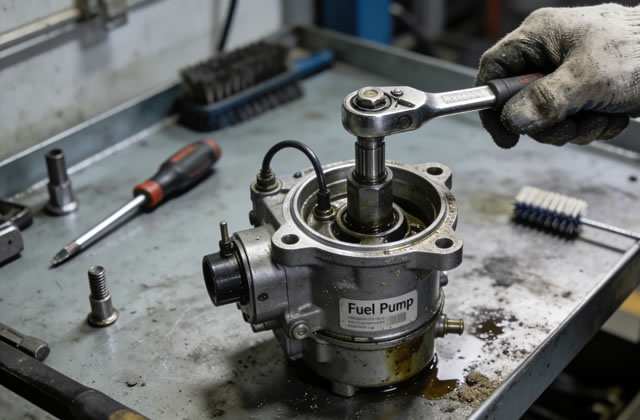
4.1 Full Fuel Pump Replacement (Step-by-Step)
If maintenance fails to resolve issues, replace the fuel pump with a CAT OEM replacement:
- Disconnect all fuel lines (label them to avoid misconnection) and electrical connectors.
- Remove mounting bolts securing the pump to the engine block.
- Carefully remove the old pump—note the orientation for reinstallation.
- Clean the pump mounting surface to remove debris or old gasket material.
- Install a new OEM gasket on the mounting surface.
- Position the new pump and tighten mounting bolts to CAT torque specs (use a torque wrench).
- Reconnect fuel lines (verify correct routing) and electrical connectors.
- Prime the fuel system and start the engine—check for leaks and verify pressure.
5. Post-Maintenance Verification
After maintenance/repair, confirm the fuel pump is operating correctly:
- Start the engine and let it run for 5-10 minutes—check for fuel leaks.
- Re-test fuel pressure to ensure it meets CAT specifications.
- Monitor engine performance (idle smoothness, acceleration, power output).
- Record maintenance in the equipment log (date, hours, tasks performed).
6. Long-Term Care Tips
- Use only clean, high-quality diesel fuel (meet CAT’s fuel quality standards).
- Keep the fuel tank at least ¼ full to prevent condensation (water damage to pump).
- Perform regular fuel system cleaning (every 1000 operating hours).
- Store equipment in a dry, covered area to avoid corrosion of pump components.
- Follow CAT’s recommended maintenance schedule (do not extend intervals for heavy use).
7. Conclusion
Proper maintenance of your CAT fuel pump is the key to maximizing engine lifespan, reducing downtime, and lowering repair costs. By following OEM guidelines, using genuine CAT parts, and performing routine inspections, you can ensure your fuel pump operates reliably in even the harshest conditions. For complex repairs (e.g., internal pump calibration), always consult a certified CAT technician to avoid costly mistakes.