


Best Practices for Ensuring Reliable Performance of Jenbacher Gas Engine AVR Systems
1. Overview of Jenbacher AVR
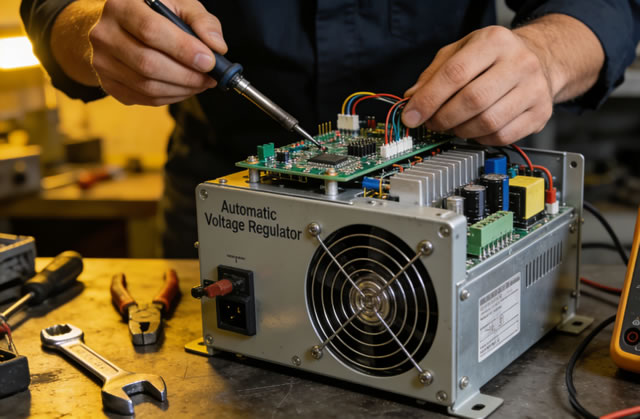
The Automatic Voltage Regulator (AVR) is a critical component in Jenbacher gas engine generator sets, responsible for maintaining a stable output voltage under varying load conditions. Jenbacher AVRs are engineered to meet the high reliability standards of industrial power generation, supporting models such as J312, J420, J620, and J920 series engines. The core function of the AVR is to adjust the excitation current of the generator's alternator, ensuring that the output voltage remains within the specified range (typically 400V/230V for 50Hz systems or 480V/277V for 60Hz systems) regardless of load fluctuations, temperature changes, or other operational variables.
Key components of a typical Jenbacher AVR include: voltage sensing circuits, error amplifiers, power semiconductor modules, excitation control relays, voltage adjustment potentiometers, and protective circuitry (overvoltage, undervoltage, overcurrent protection). These components work in tandem to provide precise voltage regulation, with a typical regulation accuracy of ±1% for Jenbacher units.
2. Daily Inspection and Preventive Maintenance
Preventive maintenance is essential to minimize unplanned downtime and extend the service life of the Jenbacher AVR. Below is a structured daily/weekly inspection checklist and maintenance procedure:
2.1 Visual Inspection
- Check for physical damage (cracks, corrosion, or loose connections) on the AVR enclosure and terminal blocks.
- Inspect wiring harnesses for fraying, insulation damage, or loose terminals; ensure all connections are torqued to Jenbacher's specified values (typically 4-6 Nm for terminal screws).
- Verify that the AVR cooling vents are free of dust, debris, or oil buildup (blocked vents can cause overheating and premature failure).
- Check for oil or coolant leaks near the AVR (common in Jenbacher engines due to proximity to engine components; leaks can cause short circuits).
2.2 Functional Checks
- Measure the generator's output voltage at no-load and full-load conditions using a calibrated multimeter; confirm it is within ±1% of the nominal voltage.
- Test the voltage adjustment potentiometer (if equipped) to ensure smooth adjustment of output voltage within the allowable range (typically ±5% of nominal).
- Verify that the AVR's protective functions (overvoltage/undervoltage trip) are active by simulating fault conditions (follow Jenbacher service manual guidelines to avoid damage).
- Check the AVR's temperature (operating temperature should not exceed 70°C; use an infrared thermometer to measure the heatsink temperature).
2.3 Routine Cleaning
Clean the AVR enclosure and heatsinks every 3 months (or more frequently in dusty environments) using compressed air (max pressure 2 bar) to remove dust and debris. Avoid using water or chemical cleaners, as they can damage electronic components. For oil-contaminated components, use isopropyl alcohol and a lint-free cloth to gently wipe the surface.
3. Troubleshooting Common AVR Faults
| Fault Symptom | Possible Causes | Repair/Resolution Steps |
|---|---|---|
| No output voltage from generator | 1. Blown fuse in AVR power supply 2. Failed voltage sensing circuit 3. Open excitation winding 4. Defective power semiconductor module |
1. Replace the fuse with Jenbacher OEM part (match amp rating) 2. Test sensing circuit with multimeter; replace faulty sensors 3. Check excitation winding continuity; repair or replace if open 4. Replace defective power module with genuine Jenbacher component |
| Fluctuating output voltage | 1. Loose wiring connections 2. Worn voltage adjustment potentiometer 3. Faulty feedback signal 4. Overheating of AVR components |
1. Retorque all terminal connections to spec 2. Clean or replace potentiometer 3. Verify feedback wiring integrity; recalibrate feedback signal 4. Improve cooling (clean vents, check fan operation) |
| Overvoltage trip | 1. Malfunctioning error amplifier 2. Stuck voltage adjustment potentiometer 3. Failed overvoltage protection relay 4. Incorrect calibration |
1. Test amplifier output; replace if faulty 2. Replace potentiometer and recalibrate 3. Replace protection relay 4. Recalibrate AVR per Jenbacher service manual |
| AVR overheating | 1. Blocked cooling vents 2. Overloaded excitation current 3. Defective cooling fan (if equipped) 4. Ambient temperature exceeding 40°C |
1. Clean vents and heatsinks 2. Check load on generator; reduce if overloaded 3. Replace cooling fan 4. Improve ventilation in generator room |
4. Periodic Maintenance (Scheduled Servicing)
Jenbacher recommends scheduled maintenance for AVR systems based on operating hours, as outlined below:
4.1 2,000 Operating Hours / 6 Months
- Complete visual and functional inspection (per Section 2)
- Check and tighten all electrical connections (torque to Jenbacher specs)
- Clean AVR heatsinks and enclosure
- Verify calibration of voltage setpoints
4.2 8,000 Operating Hours / 2 Years
- All 2,000-hour maintenance tasks
- Test all protective relays and sensors
- Inspect power semiconductor modules for signs of degradation (bulging, discoloration)
- Recalibrate the AVR using Jenbacher OEM calibration tools (e.g., Jenbacher Service Tool JST)
4.3 16,000 Operating Hours / 4 Years
- All 8,000-hour maintenance tasks
- Replace worn components (potentiometers, relays, capacitors)
- Test insulation resistance of AVR wiring (minimum 1 MΩ at 500V DC)
- Consider full AVR overhaul or replacement if performance degradation is detected
5. Repair Best Practices
When repairing a faulty Jenbacher AVR, adhere to the following best practices to ensure long-term reliability:
- Use only genuine Jenbacher OEM parts for replacements – non-OEM parts may not meet performance standards and can void the warranty.
- Follow the torque specifications provided in the Jenbacher Service Manual for all electrical and mechanical connections.
- After repair, perform a full functional test (no-load, half-load, full-load) to verify voltage regulation accuracy and protective function operation.
- Document all repairs, including component replacements, calibration values, and test results – this aids in future troubleshooting and compliance with maintenance records.
- If the AVR has suffered water/oil damage, replace all affected components (not just the visibly damaged ones) to prevent latent failures.
6. Safety and Compliance
Additional safety guidelines:
- Wear appropriate PPE (Personal Protective Equipment): insulated gloves, safety glasses, and anti-static wristbands when handling AVR components.
- Ensure the generator is properly grounded per local electrical codes and Jenbacher guidelines.
- Do not bypass protective circuits (overvoltage, undervoltage, overcurrent) – this can lead to catastrophic generator failure.
- Store replacement AVR components in a dry, temperature-controlled environment (15-25°C) to prevent moisture damage.
- Comply with local environmental regulations when disposing of old AVR components (e.g., capacitors, PCBs) – do not discard as general waste.