




Best Practices for Extending Service Life and Ensuring Optimal Performance
1. Introduction to CAT Bearings
Caterpillar (CAT) bearings are critical components in heavy-duty machinery, including construction equipment, agricultural vehicles, and industrial engines. Designed to withstand extreme loads, high temperatures, and harsh operating conditions, these bearings play a pivotal role in ensuring smooth rotation, reducing friction, and preventing premature wear of mechanical parts. Proper maintenance is not only essential for maximizing the service life of CAT bearings but also for minimizing downtime, reducing repair costs, and maintaining the overall safety and efficiency of CAT equipment.
2. Routine Inspection Procedures
Regular inspections are the foundation of effective CAT bearing maintenance. Inspections should be conducted at scheduled intervals (refer to the CAT equipment manual for specific timelines) and immediately after any abnormal operation (e.g., unusual noise, vibration, or overheating).
2.1 Visual Inspection
- Check for signs of physical damage (e.g., cracks, dents, or deformation) on the bearing raceways, rollers, or cages.
- Inspect for corrosion, rust, or discoloration caused by moisture, chemical exposure, or inadequate lubrication.
- Examine the seal and shield for damage, leaks, or contamination (e.g., dirt, debris, or metal shavings).
- Verify the alignment of the bearing with adjacent components (misalignment is a leading cause of premature failure).
2.2 Functional Inspection
- Rotate the bearing manually (when safe to do so) to check for smooth operation—any grinding, clicking, or rough movement indicates potential issues.
- Measure temperature using a non-contact infrared thermometer; abnormal heating (above 90°C for most CAT bearings) signals friction or lubrication problems.
- Check for excessive axial or radial play using precision gauges (follow CAT’s specified tolerance limits).
Quick Inspection Checklist
- Clean the bearing surface before inspection to avoid misdiagnosis from external debris.
- Document all findings (e.g., damage, temperature readings, play measurements) for trend analysis.
- Compare inspection results against CAT’s OEM specifications to identify deviations.
3. Lubrication Best Practices
Lubrication is the single most important factor in CAT bearing maintenance. The right lubricant, applied correctly, reduces friction, dissipates heat, and protects against corrosion and contamination.
3.1 Selecting the Correct Lubricant
Always use lubricants recommended by Caterpillar for your specific bearing model:
- For high-load, high-temperature applications: CAT Heavy Duty Grease (e.g., CAT BEACON™ Grease or CAT Multi-Purpose Grease MP).
- For extreme pressure (EP) conditions: CAT EP Grease (meets ASTM D4950 standards).
- For submerged or wet environments: CAT Water-Resistant Grease (WRG) to prevent washout.
3.2 Lubrication Application Guidelines
| Maintenance Task | Frequency | Application Method | Key Notes |
|---|---|---|---|
| Grease Replacement | Every 250 operating hours (or as per manual) | Grease gun (pressurized) or manual packing | Remove old grease completely before adding new grease |
| Top-Up Lubrication | Every 50 operating hours | Grease fitting (zerk fitting) injection | Do not over-grease (excess causes overheating) |
| Initial Lubrication (New Bearings) | Before installation | Hand packing (fill cage and raceways) | Ensure 100% coverage of all moving surfaces |
4. Cleaning and Reconditioning
Over time, CAT bearings accumulate dirt, metal particles, and degraded lubricant, which accelerate wear. Proper cleaning is essential during scheduled maintenance or before reinstallation.
4.1 Safe Cleaning Steps
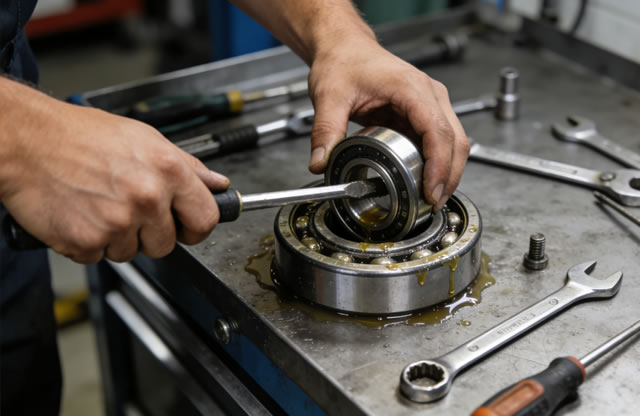
- Remove the bearing from the equipment, taking care to avoid damaging adjacent components (use pullers designed for CAT bearings to prevent forceful removal).
- Wipe off excess grease and surface debris with a lint-free cloth.
- Clean the bearing using a CAT-approved solvent (e.g., CAT Solvent Cleaner) or mineral spirits—avoid harsh chemicals (e.g., bleach or acid) that damage bearing materials.
- Use a soft-bristled brush to clean hard-to-reach areas (e.g., cage pockets, raceway grooves) without scratching the surface.
- Rinse the bearing with clean solvent to remove residual dirt, then dry thoroughly with compressed air (keep air pressure below 20 psi to avoid damaging seals).
- Inspect the bearing again after cleaning to identify hidden damage (e.g., pitting or fatigue cracks).
4.2 Reconditioning Criteria
Recondition (regrind, polish, or replace components) only if the bearing meets CAT’s reconditioning standards:
- Minor surface wear (no deep scratches, pitting, or cracks).
- Raceway and roller dimensions within OEM tolerance limits.
- No deformation of the cage or seal assembly.
Replace the bearing immediately if it fails any of these criteria—reconditioning a damaged bearing will lead to premature failure and safety risks.
5. Installation and Alignment
Improper installation is a major cause of CAT bearing failure. Follow these steps to ensure correct fitting:
- Ensure the bearing seat (housing/shaft) is clean, free of burrs, and within CAT’s specified dimensional tolerances.
- Use press-fit tools (not hammer strikes) to install the bearing—direct impact damages raceways and rollers.
- Align the bearing with the shaft/housing to within 0.02 mm of parallelism (use dial indicators for precision).
- Torque mounting bolts to CAT’s recommended specifications (over-torquing causes distortion; under-torquing leads to looseness).
- After installation, run the equipment at low speed for 10–15 minutes to check for abnormal noise, vibration, or temperature rise.
6. Troubleshooting Common Bearing Issues
| Issue | Common Causes | Corrective Actions |
|---|---|---|
| Abnormal Noise (Grinding/Clicking) | Misalignment, inadequate lubrication, contamination, or worn components | Realign bearing, reapply lubricant, clean/replace bearing, or replace worn parts |
| Overheating | Over-greasing, misalignment, excessive load, or damaged seals | Reduce lubricant volume, realign, reduce load, or replace seals |
| Corrosion/Rust | Moisture exposure, inadequate lubrication, or chemical contamination | Clean and re-lubricate, replace damaged bearings, install corrosion inhibitors |
| Excessive Play | Wear, improper installation, or material fatigue | Replace bearing, recheck installation torque/alignment |
7. Long-Term Maintenance Planning
To ensure consistent performance of CAT bearings, develop a proactive maintenance plan that includes:
- Establishing a maintenance schedule based on equipment usage (e.g., hours of operation, load intensity, and environmental conditions).
- Training maintenance personnel on CAT’s OEM procedures and safety guidelines.
- Stocking genuine CAT replacement bearings and lubricants to avoid delays in repairs (non-genuine parts may not meet CAT’s quality standards).
- Conducting quarterly reviews of maintenance records to identify trends (e.g., frequent bearing failure in specific equipment) and adjust maintenance practices accordingly.
- Partnering with authorized CAT service centers for annual equipment audits and advanced bearing diagnostics (e.g., vibration analysis or oil sampling).